“Martin had two big maples over his driveway that were dropping limbs on his car. I pruned them for clearance and took out the deadwood. He said the yard felt twice as bright and the car stayed clean through the fall.”
“Sandra's spruce had died near the river and was leaning toward the shed. I rigged it down in sections, laid mats on the soft ground, and left the lawn without a rut. She kept the wood for her fire pit.”
“David had a stump in the middle of his lawn from an old cedar. I ground it below grade, hauled out the chips, and he seeded it over. He told me it was the first time his mower did not bounce.”
“Julie's cedar hedge had grown into the neighbour's driveway. I trimmed both sides and the top, kept the lines straight, and cleaned up every clipping. She said it looked like a proper village hedge again.”
Brush Chipping in Warsaw, Ontario

I chip brush in Warsaw and around the village lots near the river, where mature trees drop a lot of material after a windstorm or a heavy pruning. The lots here are often tight, with fences, sheds and garden beds close to the trunks, so I lay mats on soft ground before I bring the chipper in. That keeps the turf from rutting and gives me a clean path to work. If your pile is mostly maple, oak or birch limbs, the chipper turns them into useful mulch in one visit.
What I need from you is a pile free of stones, wire and lumber. Those three things dull the blades and slow the job down, so I sort as I go and keep the chips clean. You can keep the chips for garden beds, paths or around your trees, or I can haul them away. It is also the easiest way to deal with limbs brought down by an ice storm without dragging everything to the curb and waiting for pickup. On the older village properties, access can be narrow, so tell me roughly how big the pile is and whether a machine can get to it.
I work on your private property only, and I stay clear of the hydro lines that feed your service entrance. If a branch is close to that wire, I will tell you what I can and cannot do safely. For brush chipping in Warsaw, call me at (249) 494-5209 for a free estimate.
Tree Planting and Transplanting in Warsaw

Warsaw is a village of river lots, and that shapes how I plant. The ground near the water is soft and often rich, which is good for roots but unforgiving for equipment, so when I bring the truck and the smaller machine onto a lawn I lay mats first and keep the travel lines tight. The lots themselves are often narrow between buildings, with mature trees already holding the canopy, and I prune those for clearance and safety before I add anything new. Planting well here means reading what is already overhead and underground, not just digging a hole in the open spot.
Species come next. Around Warsaw I work with native maples, serviceberry, white pine and tamarack, and I match them to the soil in front of me rather than to a catalogue. I set each tree at the correct depth, with the root flare showing and no mulch piled against the trunk, because a buried flare is the slowest failure I see. I stake only when the site genuinely needs it, and I come back to pull the stakes once the roots have taken hold. I can also move a smaller tree within your own property with a full root ball, ideally while it is dormant.
If you are thinking about a new tree, or about relocating one that is now in the wrong place, call me at (249) 494-5209 and I will come out for a free estimate.
Tree Disease Treatment in Warsaw, Ontario

When a tree in Warsaw starts dropping leaves in July, oozing dark sap from the bark, or thinning at the top while the rest still looks green, the cause is rarely obvious from the road. I walk the whole property before I touch anything: leaves, bark, the flare at the base, the soil around the roots. On the village lots near the river, I often find mature maples and oaks with old storm wounds, and the 2022 derecho left its share of torn limbs that never sealed properly. Rot moves into those breaks slowly, and by the time the crown shows dieback, the decay has been working for years. It can be a fungal disease, a canker, or simple decay, and each one calls for a different response.
Warsaw has its own constraints. The ground near the river stays soft well into spring, so when I bring the machine in I lay mats down first to protect the lawn and keep from chewing ruts into wet soil. Access between older village homes can be tight, and I would rather carry brush out by hand than tear up a fence or a garden bed. On the mature trees along those lots, my first goal is clearance and safety: pruning out dead wood, opening the canopy, and taking weight off limbs that lean over a roof or a driveway. Some problems respond well to pruning and better care around the roots. Others need treatment, and a few trees are better replaced before the next big windstorm takes the decision out of your hands.
I will not sell you a treatment your tree does not need, and I will tell you plainly when removal is the honest answer. If the tree is worth saving, I explain what I see, what I would do, and what to watch for over the next season. The estimate is free, so call (249) 494-5209 and I will come out and look at it with you.
Tree Trimming in Warsaw, Ontario
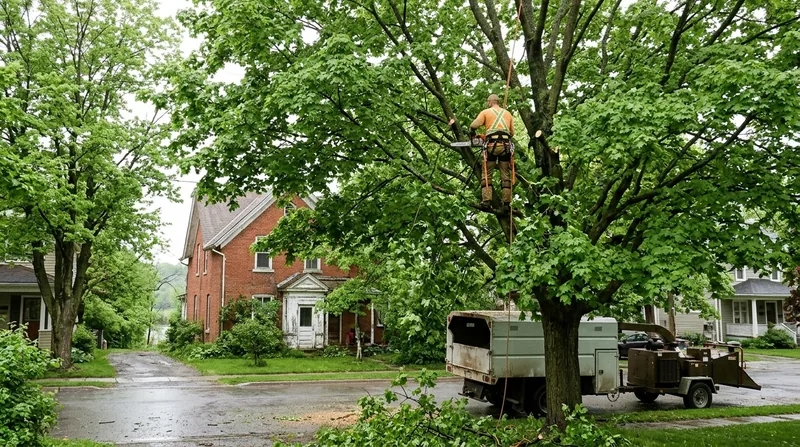
Warsaw is the kind of village where the trees were planted before the houses were finished, and it shows. The lots near the river hold mature maples and big old oaks with limbs that have had decades to reach out over rooflines, driveways and fences. When I trim in Warsaw, most of the work is about clearance and safety: lifting a low crown so the mower and the truck can pass, cutting back the branch that scrapes the shingles, and taking out the crossing limbs that rub and open wounds. I prune those village trees so they keep their shape, because a mature maple that has grown with a house should still look like that maple when I leave.
I work the ground carefully here. Soft lawns near the water and narrow side yards between older homes mean I lay mats down before I bring a machine in, and I lower anything heavy by rope rather than let it drop onto a garden or a fence. I take out the deadwood and the weak unions that our spring winds and heavy snow load find first, and I lift the canopy where you need room for a vehicle or a sightline. What I will not do is top a tree or strip the inside of the canopy bare. That is not trimming, it is damage, and a tree treated that way spends years trying to recover.
If you have a maple that has outgrown the yard, branches over a neighbour's fence, or a limb sitting too close to your private service entrance, call me and I will come look at it. I keep my distance from the hydro line itself and work only on the clearance around the wire that runs to your own house. The estimate is free, and I clean up every branch and rakings before I pull out of the driveway. Call The Peterborough Arborist at (249) 494-5209 to book yours.
Tree Removal in Warsaw, Ontario
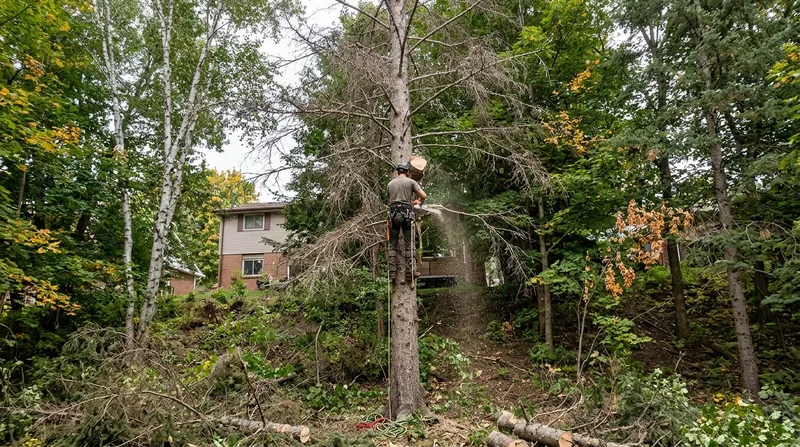
In Warsaw, the village lots close to the river hold mature trees that have been there longer than most of the houses. I see big maples and oaks with wide crowns, cedars that have grown thick along property lines, and the occasional spruce that has seen better decades. When a tree on one of these lots has to come down, it is rarely a simple drop. The backyards are often tight, the ground near the water can be soft, and there is frequently no machine access. I take those trees down in sections, working from the top with ropes and rigging so each piece is lowered exactly where I want it. When I bring a machine onto soft ground, I lay mats first to protect the lawn and keep the truck from sinking.
Before I cut, I check the permit situation. Peterborough's Tree Removal By-law covers most trees on private property, and there is a simpler path for dead trees or those hit by emerald ash borer. I would rather spend ten minutes confirming that than have a homeowner face a problem later. Ash borer has left a lot of brittle wood standing in this area, and brittle wood is dangerous wood. If a tree is leaning toward the house or has already lost limbs, I treat it as a priority. I do not top trees, and I will tell you if a removal is not necessary.
Once the tree is down, I chip the brush and either haul the wood away or cut it to length for you, depending on what you want. The work is documented so you have a clear record of what was done. If you have a tree in Warsaw that concerns you, call me at (249) 494-5209 for a free estimate. I will look at it, explain your options, and give you a straight answer.
Warsaw, as the arborist sees it
I work Warsaw's village lots along the river, and the trees there are the reason I keep coming back. Warsaw sits on ground that holds moisture, and the mature maples, cedars and old spruces grow close to the houses, their canopies reaching over roofs and driveways. When I walk those properties in spring, I look for the first signs of bud break on the maples and the winter dieback on the cedars. In summer, the river side stays cool and shaded, but that also means limbs hang low over paths and parked cars. I prune for clearance and safety, not for the sake of cutting. I take out the deadwood, lift the low limbs, and thin the crown so wind can pass through instead of pushing the tree over. On soft ground, I lay mats before I bring a machine in, because a chipper or a lift can rut a wet lawn in minutes. I see the same pattern every season: trees that were planted when the houses were built now need a real pruning cycle, and a few ash are declining. I climb what I can and rig what I cannot, and I leave the woodpile where the homeowner wants it. If you are near Warsaw Community Centre or along the river road, you have probably seen my truck. I also pass Warsaw Memorial Park on my rounds, where the older trees show what happens when pruning is put off too long. My work here is the same as anywhere: look first, explain what I see, and only remove what has to go.
What makes Warsaw different from a city lot is the mix of space and constraint. The lots are generous, but the trees are close to the buildings and the river sets the water table. I watch the freeze-thaw in late winter and the ice storm damage that follows, and I plan pruning cuts that will hold up in wind. I do not top trees, and I will tell you when a tree is better left alone. When a limb is near the service entrance, I work to clearance around the private line only, respecting the approach distances, and I never touch the utility's own lines. If a removal needs a permit, I explain that the City of Peterborough may require one for a private tree removal, and I can prepare an arborist report to support the application. I give a free estimate and I show up when I say I will.