“I have two big willows leaning over the Pigeon River and I was worried about the bank. He pruned the weight off the water side, explained why the roots hold the soil, and left the trees standing. Clean job, no mess.”
“After the last windstorm a maple limb came down across my drive. He came out, cut it up, chipped the brush and checked the rest of the tree for cracks. Told me straight what needed to go and what was fine.”
“Had a dead spruce too close to the house. He walked the yard first, pointed out the gate was too narrow for the chipper and planned around it. Removed the tree, ground the stump, and the lawn was back to normal.”
“My cedar hedge was overgrown and blocking the light. He trimmed it back evenly, cleaned up every clipping, and told me the best time of year to do it again. No pressure, just good advice.”
Tree Removal in Omemee, Done Section by Section
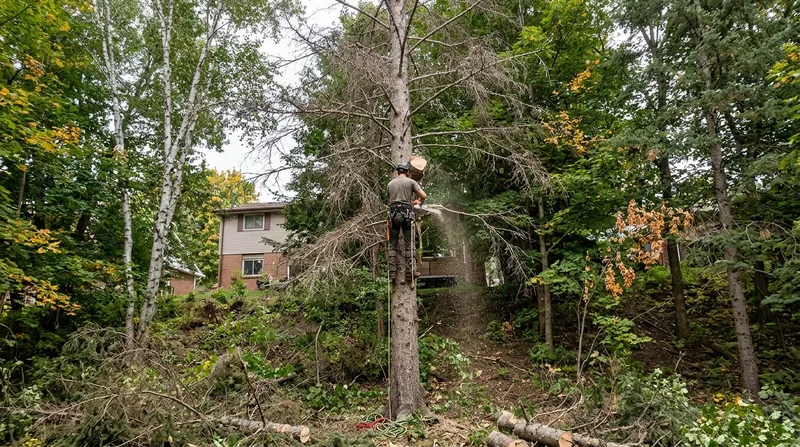
Omemee sits right on the Pigeon River, and that shapes how I take a tree down here. Riverside lots and backyards that slope toward the water leave little room to drop anything whole, so I climb and rig: I work from the top, rope each section, and lower it exactly where I want it. No crashing limbs into a shed, a fence, or the riverbank. On the streets around town I see a lot of mature maple, oak, and birch, plus spruce in the tighter yards, and those canopies often reach over a roof or a neighbour's property line. When I look at a removal, I am checking the lean, the root flare, and how much space I have to land pieces.
Ash is the other story. Emerald ash borer has left a lot of trees brittle, and a dead ash is a different job: the wood can snap without warning, so I plan every cut and keep the drop zone clear. If a tree is dead or clearly an ash borer case, the permit path is simpler, but I still check with the City of Peterborough before I cut, because a removal on private property may need a permit and I would rather sort that out first than stop halfway. I also tell you about access before I book the job: whether my truck and chipper fit through the gate, whether the backyard is a tight squeeze with no machine access, and what that means for how the work gets done.
Once the tree is down, I chip the brush and either haul the wood away or cut it to length and stack it for you. If you have a tree that is dead, leaning toward the house, or too brittle to trust, call me at (249) 494-5209 for a free estimate.
Cedar Hedge Trimming in Omemee

I trim cedar hedges in Omemee and along the Pigeon River, where the lots tend to run deep and the soil stays heavy through spring. Cedar does well in that ground, but it also pushes fast, and most of the hedges I look at here were left a season too long. When I shape one, I cut the sides flat and leave the top slightly narrower than the base. That taper lets sunlight down to the lower branches, which is what keeps a hedge green to the ground instead of bare at the bottom and thick on top.
If yours has gone wild, I bring it back over two or three seasons rather than cutting hard into old wood. Cedar will not regrow from bare branches, so a single aggressive pass leaves a permanent gap. I also clean out the brown, dead patches that winter burn and snow load leave behind, and I watch the riverside properties closely: wet ground and wind off the water mean a hedge needs to be dense low down to hold up. Before I book anything, I tell you about access. Some Omemee yards have narrow gates or a slope down to the river, and that changes how I set up and how I haul clippings out.
All clippings are collected and taken away, and I give you a free estimate on the spot. Call (249) 494-5209 and I will look at your cedar hedge in Omemee and tell you honestly what it needs this season.
Stump Grinding in Omemee, Done Right

When I grind a stump in Omemee, the first thing I look at is the river. Properties along the Pigeon River tend to sit lower and hold more moisture, and the maples, willows and cedars that grow there send out surface roots well past the trunk. A stump left standing in that kind of ground is more than an eyesore: it is a trip hazard on uneven turf, it catches mower blades, and it gives insects and rot a place to settle. I bring a compact grinder that fits through a standard gate, so I can reach a backyard without dragging equipment across your lawn or tearing up the grass to get there.
I grind the stump below grade and chase the surface roots around it, because those roots are what heave a lawn and blunt a mower deck later. Then you choose what happens to the chips: I leave them to fill the hole, which settles nicely for a planting bed, or I haul them away if you want a clean surface. On the older riverside lots I often find damp soil and roots that run shallow, and I will tell you about any access issue, a narrow gate, a fence line, a slope down to the water, before I book the job. Nothing surprises you on the day.
If you plan to put a new tree in that spot, lay sod or build there, say so when you call. I will grind deeper and clean the area more thoroughly so the ground is ready for what comes next, rather than just level with the lawn. Every job starts with a free estimate, and I would rather look at the stump in person than guess over the phone. Call (249) 494-5209 to book yours.
Tree Pruning in Omemee, Done for Tree Health

In Omemee, most of the work I do is on riverside lots along the Pigeon River and on the mature yard trees behind the older houses. Those trees carry a lot of history: silver maple and willow near the water, spruce and cedar hedges on the property lines, and the occasional oak or birch that someone planted decades ago. Riverside ground is soft and often wet, so before I book anything I walk the property and tell you straight about access. If my truck and chipper cannot get through a gate or down a slope, you hear it from me up front, not on the morning of the job.
Pruning is about the tree's health more than its looks. I remove deadwood, rubbing branches and weak forks that tend to fail in windstorms, and I train young trees early so they grow a strong frame instead of a future problem. After the May 2022 derecho tore through the Peterborough area's canopy, I look closely at every union, every crack and every lean before I cut. On the riverside trees here, clearance matters too, both over the water and over the roof, and I keep the shape natural rather than shearing it back. For most trees, late fall through early spring is my preferred window, when the structure is bare and the cuts heal clean.
I explain every cut before I make it, so you know what is coming off and why. If a tree does not need work, I will tell you that as well. The estimate is free, so call (249) 494-5209 and I will come out to Omemee to look at your trees and talk through the options.
Tree Cabling and Bracing in Omemee

Omemee sits on the Pigeon River, and that river shapes the work I do here. Riverside lots hold mature willow, silver maple and Manitoba maple, and those trees grow fast and wide over water, which means long, heavy limbs reaching for light and a fork that never had to fight for space. Add the clay ground and the freeze-thaw we get each spring, and you end up with unions that open slowly over the years. I climb the tree, look at the fork and the wood around it, and I check the lean of the whole crown before I say a word about whether it can be saved.
When the tree is otherwise healthy and the weak point is a fork or a split limb, I install flexible cables high in the crown so the limbs share the load in wind, snow and ice. Where a split has already opened, I add steel bracing rods through the union to hold it together. Cabling supports a tree; it does not fix rot. If the inspection shows the wood is too far gone, I tell you straight and we talk about removal instead. Around Omemee I also deal with tight riverbank access, fences close to the trunk and the odd back lane where I need to plan how the truck and chipper get in, and I flag any access issue before I book the job. I check my installations over time, and I keep notes on each one so I know what I am looking at when I return.
If you have a maple or willow on your property with a fork that worries you, or a limb that split in the last ice storm, call me at (249) 494-5209 for a free estimate and I will tell you honestly what the tree needs.
Omemee, as the arborist sees it
Omemee sits on the Pigeon River, and that river sets the rhythm of my work here. The lots closest to the water hold a mix of mature silver maples, willows and the occasional birch leaning out over the bank, while the yards a few streets back carry big old spruces, cedars hedges and hard maples that have been shading the same houses for decades. When I walk a property in Omemee, I look up before I look down: I check for dead limbs hanging over the roof, for trunks that have started to hollow at the base, and for the kind of tight branching that catches wind. Riverside trees need clearance pruning for two reasons, to keep weight off limbs that reach over the water and to open the canopy so the wind passes through instead of pushing the whole tree over. In the yards, it is usually storm resistance: removing the cracked limb after a windstorm, cabling a split crotch on an old maple, or thinning a dense spruce so snow and ice do not load it up. I prune with the season in mind, and I will tell you when a tree is better left alone. Before I book anything, I look at how my truck and chipper will get in, where the gate is, and whether a fence, a slope or a tight drive will slow us down. If there is an access issue, you hear about it from me before the job is scheduled, not on the morning of.
What I see changes through the year. In early spring I am looking at the buds and the bark cracks after the freeze-thaw cycles, and I flag the ash trees that show signs of emerald ash borer so the homeowner can plan ahead. Summer is pruning season for the riverside trees, when the leaves are full and I can see exactly which limbs are crowding the roof or the bank. After a windstorm I get calls about limbs down on lawns and driveways, and I clear what is dangerous first. In late fall and winter I do the removals that are easier on frozen ground, and I grind the stumps so the yard is usable again. If you are on the river side of things, the work is often about keeping the tree healthy and the bank stable, not about taking everything down. I give a free estimate, and I would rather spend ten minutes explaining why a tree can stay than sell you a removal you do not need.